Two energies, two routes into the skin
Sofwave is ultrasound. The manufacturer describes a thermal effect localised between 0.5 and 2 mm, centred at 1.5 mm, in cylindrical zones parallel to the skin surface, with active integrated cooling and real-time skin-temperature monitoring (Sofwave provider FAQs, accessed 24 October 2026). The Sofwave and HIFU comparison looks at that depth in more detail.
XERF is monopolar radiofrequency from Cynosure Lutronic of Goyang, South Korea. An active electrode on the treated skin and a large return electrode, or grounding pad, elsewhere on the body complete the circuit, and the current turns into heat as it meets the resistance of the tissue. The device runs at 6.78 MHz and 2.0 MHz; cryogen gas cools the surface, the tip temperature is shown with each shot, and output stops if the tip surface goes above 43 °C[1]. In its deep mode, 6.78 MHz is followed by 2 MHz within a single shot[2].
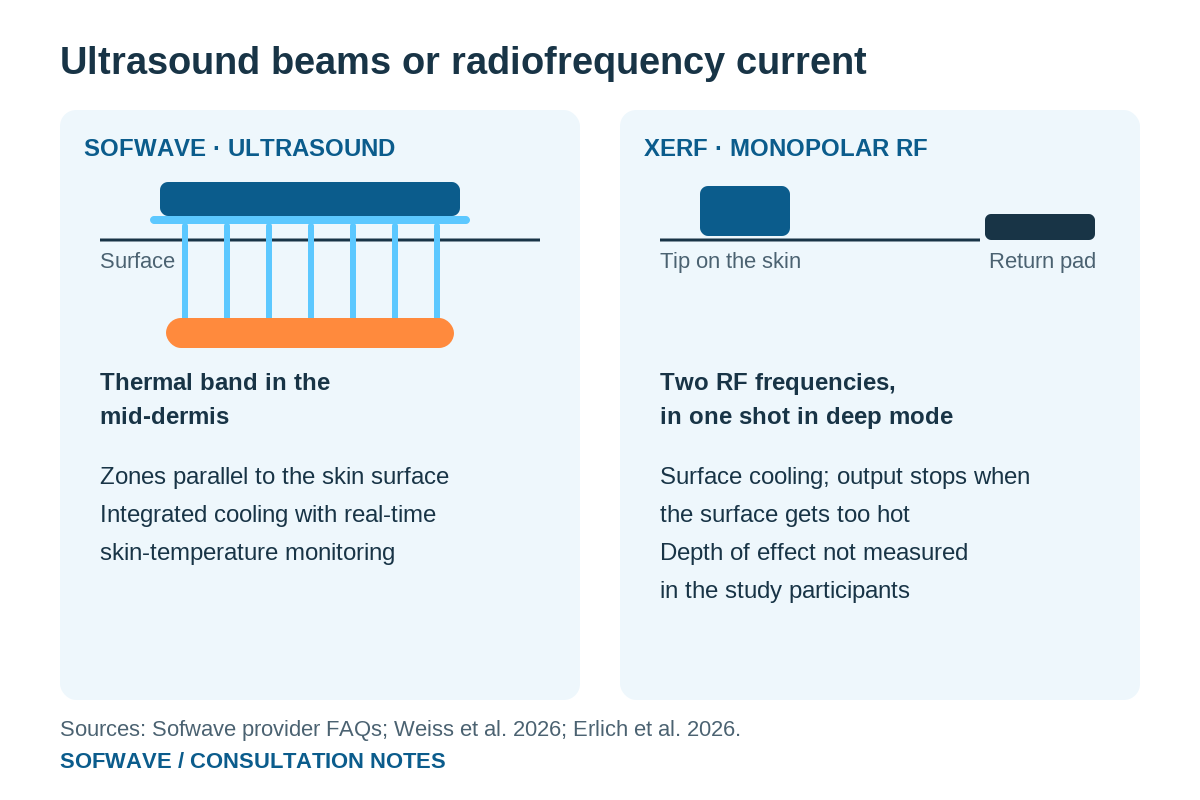
The second frequency is there to reach deeper. The multicentre XERF study describes 2.0 MHz as designed to support deeper subdermal heating, and states that the depth of tissue effect was not directly measured in its participants[1].
What the published studies measured
As of 24 October 2026, no study in PubMed had treated the same people with both devices. What exists are separate studies, each run its own way.
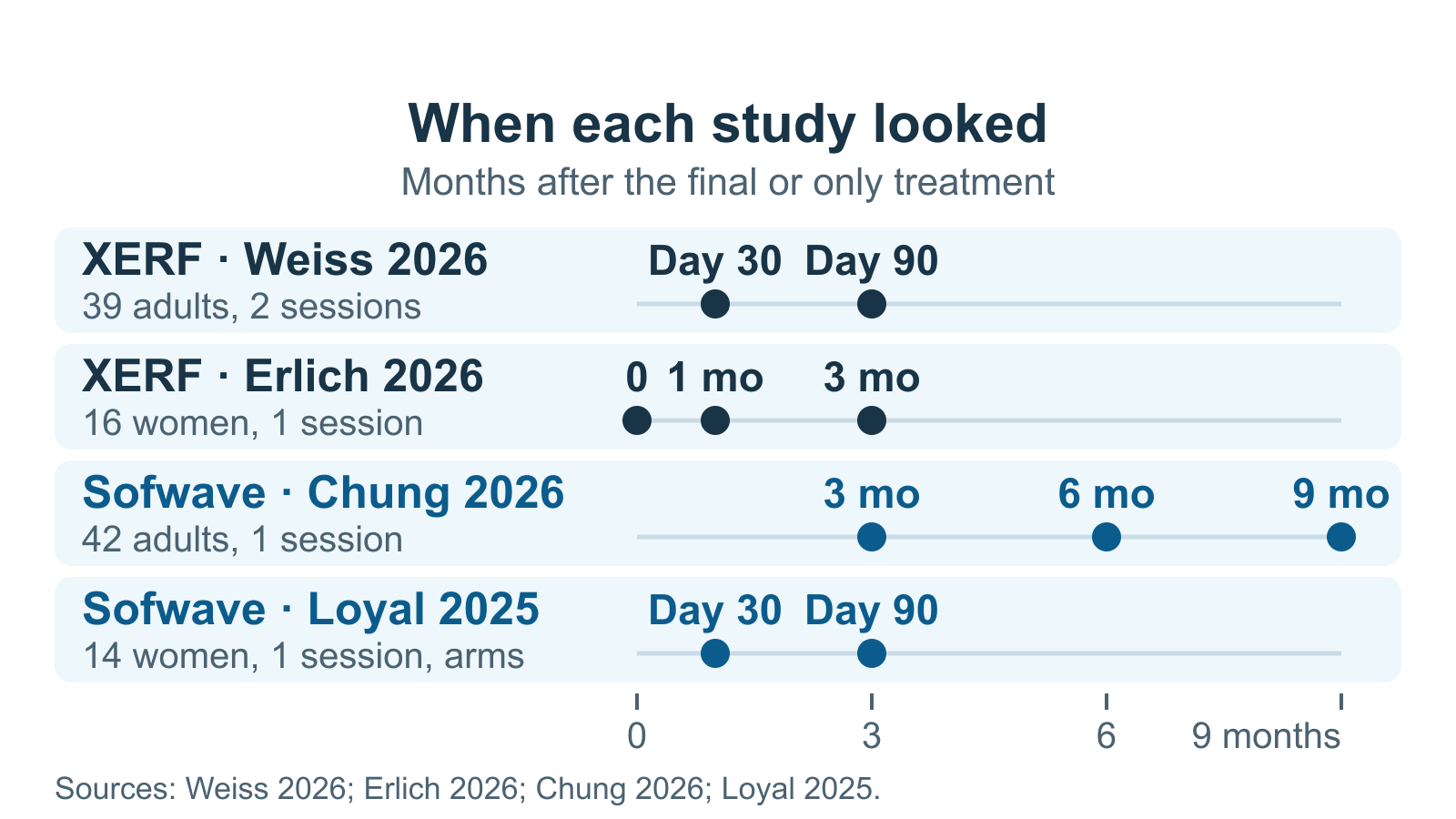
XERF, prospective. Thirty-nine adults at four centres had two sessions four weeks apart, with photographs at 30 and 90 days after the final session. The treating investigators scored the photographs without blinding, patients rated their satisfaction, and the manufacturer supplied the device and research support[1].
XERF, retrospective. The records of 16 women treated once at the first author’s clinic in January 2026 were reviewed: 3D imaging, eyebrow and eyelid measurements, skin-analysis software and patient questionnaires, immediately after treatment and at one and three months. There was no control group[2].
Sofwave, prospective. Forty-two Asian adults aged 35 to 67 had one treatment covering the face, neck and under-chin area, with follow-up visits at three, six and nine months. Two independent assessors, blinded to the time point, rated the images, and Sofwave Medical paid for the study[3].
Sofwave against microfocused ultrasound. Fourteen women completed a blinded, randomized split-body trial: one treatment to the upper inner arms, a different device on each arm, and assessments at days 30 and 90[4]. It is the one randomized comparison among these four studies, and radiofrequency was not part of it.
| Study | Design | People | Sessions | Who rated the result |
|---|---|---|---|---|
| XERF: Weiss 2026 | Prospective, four centres, no comparison group | 39 adults | Two, four weeks apart | Treating investigators, not blinded; patients rated satisfaction |
| XERF: Erlich 2026 | Retrospective review of one clinic’s records, no control group | 16 women | One | 3D imaging and skin-analysis software; patient questionnaires |
| Sofwave: Chung 2026 | Prospective, one centre, open-label, no comparison group | 42 adults | One | Two independent assessors, blinded |
| Sofwave and MFU-V: Loyal 2025 | Randomized, blinded, split-body, upper inner arms | 14 women completed | One | Investigators and participants |
Questions to take to either consultation
Which device and which tip or applicator are on the plan?
- Why it matters.
- The retrospective XERF study used different tips for different areas: 20 × 30 mm on the lower and middle face, and 10 × 10 mm followed by 10 × 5 mm on the upper face.
- What a good answer includes.
- The device, the tip or applicator, and how many shots or pulses each area will get.
- Treat with caution.
- A package name such as “RF lifting” with no device or tip named.
How many sessions, and when is the review?
- Why it matters.
- One XERF study gave two sessions four weeks apart; the other XERF study and the Sofwave facial study gave one.
- What a good answer includes.
- A session count and a review date you can keep from home.
- Treat with caution.
- An open-ended package with no review.
Which depth or mode will you use on each area?
- Why it matters.
- In the multicentre XERF study, shallow, middle or deep settings were chosen by the target condition and facial zone; Sofwave’s thermal band is centred at 1.5 mm.
- What a good answer includes.
- A setting named for each area, with the reason for it.
- Treat with caution.
- The same setting everywhere, with no reason given.
How will the skin surface be protected?
- Why it matters.
- Both XERF studies describe surface cooling and a cut-off when the surface temperature passes 43 °C; Sofwave uses integrated cooling with real-time skin-temperature monitoring.
- What a good answer includes.
- The cooling and temperature check that will be used in your session.
- Treat with caution.
- No answer about cooling.
What will be done about discomfort?
- Why it matters.
- One XERF study used no numbing cream, the other applied it only on request, and the Sofwave facial study used lidocaine cream under film for 45 minutes.
- What a good answer includes.
- A plan for numbing, cooling and pauses, agreed before you start.
- Treat with caution.
- An assurance that everyone tolerates it, with no plan.
Who do I contact if a reaction appears after I fly home?
- Why it matters.
- Follow-up after departure is easier to arrange before treatment than after it.
- What a good answer includes.
- A named contact, a reply time and a list of what to send.
- Treat with caution.
- A general enquiry address and nothing more.
If a reaction does appear later, the after-you-fly-home contact routes set out who to tell and how device reports work.
Booking either one in Seoul
Match the device named on the quote to Korea’s device record before you book, as the device check explains for Sofwave, and compare quotes by area and number of sessions rather than by total (reading a quote). For where ultrasound and radiofrequency sit among other non-surgical options, an evidence summary of non-surgical lifting sets the main studies side by side.
Is XERF the same kind of treatment as Sofwave?
No. XERF is monopolar radiofrequency, with a tip on the skin and a return pad on the body[1]. Sofwave is ultrasound delivered as parallel beams to a band centred 1.5 mm below the surface. Sofwave provider FAQs (accessed 24 October 2026).
Where does the XERF return pad go?
On the body, away from the treated area. In the retrospective study it was placed on the lower left side of the waist[2].